


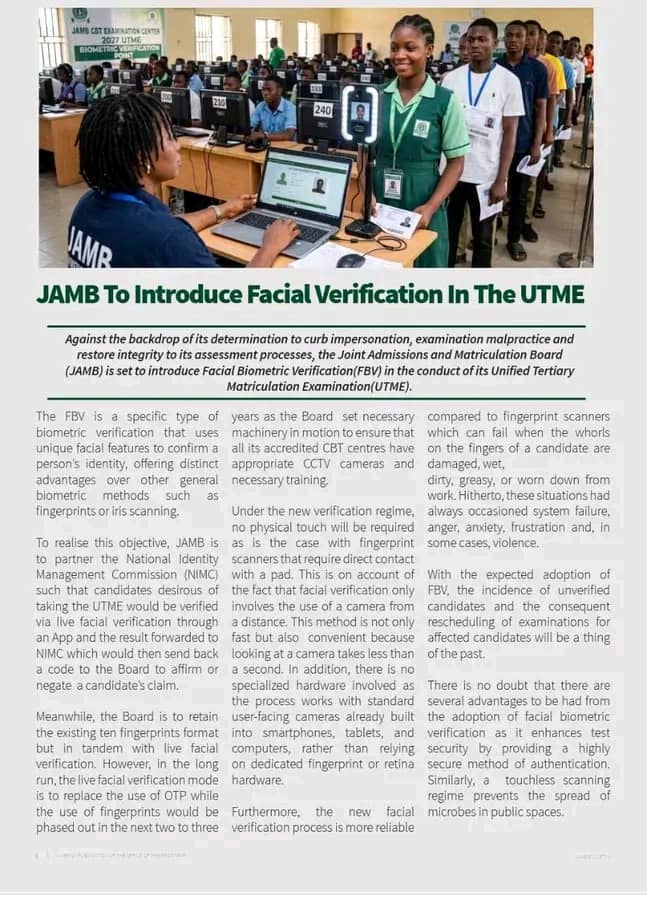
The Joint Admissions and Matriculation Board (JAMB) is set to introduce Facial Biometric Verification (FBV) in the conduct of the 2027 Unified Tertiary Matriculation Examination (UTME) as part of efforts to strengthen examination security, curb impersonation and improve the candidate verification process.
The proposed facial verification system will provide an additional method of confirming the identity of candidates during the UTME. The initiative is expected to complement the existing biometric verification system currently used by JAMB.
JAMB Facial Verification for 2027 UTME
According to information released by the Board, the Facial Biometric Verification (FBV) system will use a candidate’s unique facial features to confirm their identity.
JAMB explained that the system is designed to provide a more convenient and reliable method of authentication compared with some existing biometric methods, particularly fingerprint scanning.
Under the proposed arrangement, candidates will be verified through a live facial scan using a camera. The captured facial information will be processed for identity verification as part of the examination process.
The initiative is being introduced against the backdrop of JAMB’s efforts to curb impersonation, examination malpractice and other forms of irregularities associated with the UTME.
How JAMB Facial Biometric Verification Will Work
The proposed facial verification process will involve the use of a camera to capture the candidate’s face from a distance.
JAMB is expected to collaborate with the National Identity Management Commission (NIMC) to facilitate the verification process. Candidates taking the UTME may have their identities verified through live facial verification, with the result forwarded to NIMC for authentication.
Following the verification process, a code may be sent back to JAMB to either affirm or reject the candidate’s identity claim.
This approach is expected to make candidate authentication faster while reducing the need for physical contact with biometric devices.
JAMB to Retain Fingerprint Verification During Transition
The introduction of facial verification does not mean that fingerprint verification will immediately disappear from JAMB’s examination processes.
The Board plans to retain its existing 10-fingerprint biometric format while facial verification is introduced.
However, JAMB indicated that, in the long term, the live facial verification system is expected to replace the use of OTP, while fingerprint authentication could gradually be phased out over the next two to three years.
This means that candidates should continue to comply with all biometric requirements communicated by JAMB until the Board announces any official changes to its registration and examination procedures.
Why Is JAMB Introducing Facial Verification?
One of the major objectives of the new system is to strengthen the identification of candidates and prevent impersonation during the UTME.
Impersonation remains one of the challenges confronting large-scale examinations. By using facial characteristics to verify candidates, JAMB hopes to ensure that the individual who registered for the examination is the same person who appears at the examination centre.
The system is also expected to address some of the difficulties associated with fingerprint verification.
Fingerprint scanners may sometimes experience problems when a candidate’s fingers are wet, dirty, greasy, worn down or otherwise difficult to read. Such situations can result in verification failures and may contribute to delays and frustration during examinations.
Facial verification provides a contactless alternative, as candidates will not be required to place their fingers on a scanner.
Facial Verification Will Be Contactless
One of the notable features of the proposed JAMB facial verification system is that it will not require physical contact.
Unlike fingerprint scanners that require candidates to place their fingers on a scanning pad, facial verification uses a camera to capture the candidate’s face.
JAMB noted that the process could be completed quickly because a camera can capture a candidate’s facial features in a very short period.
The system is also expected to work with standard user-facing cameras already available on devices such as computers, tablets and smartphones, rather than relying solely on specialised fingerprint or retinal-scanning hardware.
JAMB to Strengthen CBT Centre Requirements
For the facial verification system to be effectively implemented, JAMB is expected to ensure that accredited Computer-Based Test (CBT) centres have the necessary equipment and infrastructure.
The Board is also expected to ensure that accredited CBT centres have appropriate CCTV cameras and that personnel receive the required training ahead of the implementation of the new verification system.
The additional technology is expected to strengthen security around examination centres and improve the overall monitoring of the UTME.
Benefits of JAMB Facial Verification
The introduction of facial biometric verification could provide several benefits to JAMB and UTME candidates.
1. Reduced Impersonation
Facial verification can make it more difficult for another person to sit for the examination on behalf of a registered candidate.
2. Faster Candidate Authentication
Facial recognition can capture and process a candidate’s facial features quickly, potentially reducing the time spent on biometric verification.
3. Contactless Verification
Candidates will not need to physically touch a biometric scanning device during the facial verification process.
4. Fewer Fingerprint-Related Challenges
Candidates whose fingerprints are difficult to scan may benefit from an alternative biometric verification method.
5. Improved Examination Security
The technology is expected to strengthen JAMB’s existing measures against impersonation and examination malpractice.
6. Better Candidate Experience
A fast and contactless verification process could reduce queues, delays and frustration at examination centres.
Will JAMB Stop Using Fingerprints for the 2027 UTME?
No, not immediately.
JAMB is expected to retain fingerprint verification while it gradually introduces facial biometric verification.
The Board’s plan is to operate both systems during the transition period before potentially phasing out fingerprint-based verification over the following years.
Therefore, candidates preparing for the 2027 UTME should not assume that fingerprint requirements have been cancelled unless JAMB officially announces such a change.
What 2027 UTME Candidates Should Do
Prospective candidates for the 2027 UTME should continue to monitor JAMB’s official announcements for detailed guidelines on registration and examination procedures.
Candidates should ensure that their personal information, NIN details and other registration information are accurate when registration for the 2027 UTME begins.
They should also avoid paying individuals or agents for unofficial facial verification services. Any new requirement concerning facial verification should be confirmed through JAMB’s official communication channels.
JAMB Embracing Technology in UTME Administration
The planned introduction of facial biometric verification is part of JAMB’s broader efforts to use technology to improve the administration and security of the UTME.
The Board has continued to introduce technology-driven measures aimed at making its processes more secure and efficient, while reducing opportunities for examination malpractice.
The proposed facial verification system is expected to provide another layer of security by combining biometric technology with identity verification.
If successfully implemented, it could significantly change the way candidates are authenticated during the UTME in the coming years.
Conclusion
JAMB is set to introduce Facial Biometric Verification (FBV) in the 2027 UTME as part of its efforts to combat impersonation, strengthen examination security and improve the candidate verification process.
The system will use facial recognition technology to authenticate candidates through live facial verification. JAMB plans to retain fingerprint verification during the transition, with facial verification expected to play an increasingly important role in future UTME examinations.
Candidates preparing for the 2027 JAMB UTME are advised to stay updated with official announcements and follow all instructions released by the Board when registration and examination guidelines are published.

Join Our Community
Stay ahead with exclusive campus news, admission updates, scholarships and student opportunities.
You May Also Like
More




Be the first to comment