

MODIBBO ADAMA UNIVERSITY OF TECHNOLOGY, YOLA ANNOUNCES ADMISSION INTO NEWLY APPROVED PROGRAMMES FOR 2025/2026 ACADEMIC SESSION

The landscape of higher education in North-Eastern Nigeria has received a significant boost as Modibbo Adama University (MAU), Yola, officially announced the commencement of admissions into sixteen newly approved undergraduate programmes for the 2025/2026 Academic Session. This strategic expansion follows a successful and rigorous resource verification exercise conducted by the National Universities Commission (NUC), the regulatory body overseeing university education in Nigeria.
The introduction of these programmes is not merely an increase in numbers; it represents a calculated effort by the university management to align its academic offerings with the shifting demands of the global labor market. By pivoting toward high-growth areas like Data Science, Cyber Security, and Forensic Science, while simultaneously strengthening its foundation in the Humanities through English and Islamic Studies, MAU Yola is positioning itself as a comprehensive center for excellence.
The NUC Resource Verification: A Seal of Quality
Before any Nigerian university can admit students into a new programme, it must pass a “Resource Verification” visit by the NUC. During this process, teams of experts evaluate the university’s preparedness in terms of:
-
Academic Staffing: The availability of qualified professors and lecturers with specialized knowledge in the new fields.
-
Physical Infrastructure: The adequacy of lecture halls, specialized laboratories, and workshop spaces.
-
Library Resources: Access to the latest journals, textbooks, and digital databases relevant to the specific disciplines.
-
Curriculum Standard: Alignment with the Core Curriculum and Minimum Academic Standards (CCMAS).
The approval of 16 programmes at once is a testament to the robust investment the MAU Yola management has made in institutional growth.
A Breakdown of the 16 Newly Introduced Programmes
The new offerings are diverse, cutting across technology, pure sciences, environmental studies, and the liberal arts. They can be categorized into four distinct academic clusters:
1. The Digital and Computing Cluster
In an era defined by the Fourth Industrial Revolution, MAU has introduced a suite of “future-proof” technology courses. These include:
-
BSc. Data Science: Focused on big data analytics and statistical modeling.
-
BSc. Cyber Security: Addressing the global need for digital security and threat mitigation.
-
BSc. Software Engineering: Dedicated to the design and development of robust computer systems.
-
BSc. Information & Communication Technology (ICT): A broad-based approach to digital infrastructure.
-
BSc. Information Science: Concentrating on the management and organization of digital information.
2. The Specialized Sciences and Environment Cluster
These programmes cater to the growing need for environmental stewardship and forensic investigation:
-
BSc. Forensic Science: A first-of-its-kind for many in the region, focusing on criminalistics and scientific evidence.
-
BSc. Petroleum Chemistry: Tailored for the energy sector, specifically downstream and upstream chemical processes.
-
BSc. Meteorology: Essential for climate change studies and agricultural planning in the Sahel region.
-
BSc. Applied Geophysics: Focusing on sub-surface exploration for minerals and water resources.
-
BSc. Environmental Systems: A multidisciplinary approach to ecological sustainability.
3. The Media and Communication Cluster
Recognizing the power of information, MAU has unbundled its communication offerings into specialized niches:
-
BSc. Mass Communication: The traditional, broad-based study of media.
-
BSc. Journalism and Media Studies: Focused on news gathering, ethics, and digital reporting.
-
BSc. Broadcasting: Specialized training for radio, television, and digital streaming.
4. The Arts and Humanities Cluster
The university continues to uphold cultural and linguistic scholarship:
-
B.A. English: Enhancing literacy, critical thinking, and literary analysis.
-
B.A. Arabic: Vital for regional diplomacy, historical research, and religious scholarship.
-
B.A. Islamic Studies: Focused on the theological and sociological aspects of Islamic civilization.
Admission Requirements: The Path to Enrollment
To maintain the academic integrity of these new departments, the university has set clear benchmarks for prospective students.
UTME Score Benchmark
Candidates must have attained a minimum score of 160 in the 2025/2026 Unified Tertiary Matriculation Examination (UTME). While 160 is the baseline, highly competitive programmes like Software Engineering and Cyber Security may require higher departmental cut-off marks depending on the volume of applicants.
O’Level Requirements
Candidates must possess a minimum of five (5) O’Level credit passes in relevant subjects.
-
Mandatory Subjects: English Language and Mathematics are compulsory for all 16 programmes.
-
Sittings: Credits must be obtained in not more than two sittings (e.g., a combination of WAEC and NECO is acceptable).
-
Relevance: Science-based programmes will require credits in Physics, Chemistry, and Biology, while Arts programmes will require credits in Literature in English, Government, or Religious Studies.
Application Strategy: How to Secure Your Slot
Because these programmes were approved after many candidates had already completed their JAMB registrations, the university has provided two specific pathways to facilitate enrollment.
Pathway 1: For Existing MAU Applicants (Change of Programme)
If you chose Modibbo Adama University as your First Choice but applied for a different course (perhaps one that was oversubscribed like Medicine or Engineering), you can now move to these new departments.
-
Process: Visit a JAMB CBT Centre and apply for a “Change of Course.”
-
Constraint: You must ensure your original JAMB subject combination (the 4 subjects you sat for) is compatible with the requirements of the new course. For example, moving to BSc. Cyber Security requires that you sat for Mathematics and Physics in your UTME.
Pathway 2: For New Applicants (Change of Institution)
MAU Yola is extending a “Major Opportunity” to candidates who did not initially choose the university. If you sat for the 2025 UTME and scored 160 or above, you can still join MAU.
-
Process: Log in to your JAMB CAPS profile.
-
Action: Select “Change of Institution” and set Modibbo Adama University, Yola as your First Choice.
-
Next Step: Once the change reflects, you must participate in the university’s post-UTME screening process.
Why Choose the New Programmes at MAU Yola?
The launch of these departments is accompanied by the deployment of fresh equipment and modern pedagogical methods.
-
State-of-the-Art Labs: Since these are new departments, the university has recently equipped the laboratories specifically for Forensic Science and Data Science to meet NUC’s 2026 standards.
-
Employment Prospects: Fields like Cyber Security and Software Engineering currently have the highest vacancy rates in the global tech economy. Graduates from these programmes are often “job-ready” before their final year.
-
Specialized Focus: Programmes like Meteorology and Applied Geophysics are crucial for the development of Northern Nigeria, offering career paths in government agencies like NIMET or the Ministry of Mines and Steel Development.
Institutional Commitment to Excellence
The Vice-Chancellor and the University Management have reiterated that this expansion is a “pivotal moment” for the institution. By offering 16 new pathways, MAU Yola is reducing the “admission deficit” in Nigeria, where millions of students apply for university but only a fraction find placement due to limited departmental quotas.
Prospective students are encouraged to act promptly. With the academic session already in view, the window for Change of Course and Institution through JAMB is limited. Those who delay may find the quotas for these new programmes filled by more proactive applicants.
Administrative Support and Contact Information
For candidates who encounter technical difficulties on the JAMB portal or require clarity on subject combinations, the university’s Admissions Office remains open for inquiries.
-
Location: Admissions Office, Senate Building, MAU Yola.
-
Website: Information is regularly updated on the university’s official portal.
-
Advisory: Candidates should avoid patronizing “admission agents” who promise guaranteed slots for a fee. All admissions are processed through the official JAMB CAPS and the university’s transparent screening system.
Final Word to Applicants
The introduction of Forensic Science, Cyber Security, and Journalism (among others) at Modibbo Adama University represents a significant upgrade in the intellectual capital of Yola. Whether you are a science enthusiast looking to decode digital threats or a literary mind seeking to master the English language, the 2025/2026 session at MAU offers a fresh start in a modern department.
The university is ready. The NUC has given the green light. Now, the choice is yours to “March to Excellence” in a programme designed for the world of tomorrow.

Join Our Community
Stay connected with the latest updates, exclusive content, and be part of our growing community!
Latest Posts
View AllFEDERAL UNIVERSITY OF TECHNOLOGY, OWERRI (FUTO) ANNOUNCES FINAL EXTENSION OF COURSE REGISTRATION FOR 2025/2026 ACADEMIC SESSION

The Management of the Federal University of Technology, Owerri (FUTO), has officially issued a critical administrative directive regarding the academic timeline for the current session. In a move described by the university leadership as a “magnanimous” gesture of administrative flexibility, the Office of the Registrar released an internal memorandum on February 2, 2026, announcing a further extension of the online course registration deadline for all undergraduate students.
This extension is not merely a change of dates; it is a strategic intervention designed to ensure institutional inclusivity and academic integrity. By shifting the deadline to Saturday, February 14, 2026, FUTO is providing a vital window for students facing technical, financial, or administrative hurdles to regularize their status before the implementation of strict financial penalties.
Understanding the Registration Lifecycle at a Premier University of Technology
At a specialized institution like FUTO, course registration is the digital backbone of the academic ecosystem. It is the process by which a student’s identity is synchronized with the university’s Management Information System (MIS). This synchronization affects everything from classroom allocation and laboratory scheduling to the generation of examination broadsheets.
The Role of the Registrar’s Memorandum
The memorandum serves as a formal legal instrument within the university’s governance framework. By issuing this through the Office of the Registrar, the university ensures that the directive carries the weight of the Senate’s authority. The choice of the word “magnanimous” in the memo highlights the university’s awareness of the economic and logistical pressures currently facing the student body, positioning the institution as a supportive partner in the students’ academic journey.
Deadlines and Financial Implications: The ₦10,000 Threshold
The university has established a clear boundary between the “grace period” and the “penalty phase.” Students must be acutely aware of these specific dates to safeguard their finances and academic records.
1. The Grace Period (Ending February 14, 2026)
Until the close of business on Saturday, February 14, students can access the portal without any additional charges. This period should be utilized to:
-
Finalize school fee payments.
-
Verify the accuracy of elective and core course codes.
-
Ensure that the “Units” allocated to each course align with the departmental handbook requirements.
2. The Penalty Phase (Effective February 16, 2026)
Starting from Monday, February 16, the portal will transition into “Late Registration Mode.” The system is programmed to automatically attach a Late Registration Fee of Ten Thousand Naira (₦10,000) to any profile that has not completed the submission process. This fee is non-negotiable and non-refundable, serving as a deterrent against administrative delays that hinder the university’s planning processes.
Administrative Directives to Schools and Departments
To ensure that no student can claim ignorance of this final notice, the Registrar has mobilized a top-down communication strategy. Deans of Schools and Heads of Departments (HODs) have been given a dual mandate:
-
Massive Sensitization: Utilizing departmental notice boards, official WhatsApp groups, and student union platforms to broadcast the new dates.
-
Verification of Compliance: HODs are encouraged to review their departmental registration statistics to identify students who are still “In-Progress” and nudge them toward completion before the Valentine’s Day deadline.
Technical Guide: Ensuring a Successful Online Registration
For a FUTO student, clicking “Save” is not the same as clicking “Submit.” Technical errors during registration can lead to a student being excluded from examination lists even if they have paid their fees.
Step 1: Financial Clearance
Registration is impossible without fee verification. Students must ensure their Remita payments are fully processed and reflected as “Success” on the portal. If a payment is “Pending” for more than 24 hours, the student should immediately visit the University Bursary with their evidence of payment.
Step 2: Course Selection and Credit Load
FUTO operates a strict Credit Unit System. Students must ensure they do not exceed the maximum allowable units (usually 24 units per semester) nor fall below the minimum required.
-
Core Courses: These are mandatory for your degree.
-
Elective Courses: These provide a broader academic scope but must be selected based on departmental recommendations.
Step 3: The Final Submission and Printing
Once courses are selected, the student must “Submit” the form. This action locks the selection and sends it to the Registrar’s database. Following this, the student must print the Course Registration Slip (Form 02). This slip is the only legal proof of registration required for entry into lecture halls and examination venues.
The “No Registration, No Examination” Policy
FUTO maintains a zero-tolerance policy regarding unregistered students. The university uses the registration data to print Photo-Cards and OMR (Optical Mark Recognition) sheets for examinations. If a student is not registered by the February 14 deadline (or the late registration window), their name will effectively “disappear” from the university’s active roster for the semester.
The Registrar’s memo serves as a preemptive measure to avoid the seasonal “appeals” that usually flood the Senate office once examinations begin. By providing this extension, the university is effectively removing any excuses for non-compliance.
The Impact on Final Year and Transfer Students
For two specific groups of students, this extension is particularly critical:
-
Final Year Students: Any error in registration during the final year can lead to an “Extra Semester,” delaying graduation and NYSC mobilization. They must verify that all “Carry-over” courses from previous levels are correctly added.
-
Direct Entry/Transfer Students: These students often face delays in obtaining their matriculation numbers or verifying previous transcripts. The February 14 deadline provides the necessary cushion to resolve these administrative bottlenecks.
Strategic Advice: Avoiding the “Last-Minute” Portal Traffic
History at FUTO shows that the university server often experiences significant lag or “Server 500” errors during the final 48 hours of a deadline due to thousands of students attempting to register simultaneously.
Proactive Steps for Students:
-
Do not wait until February 14: Aim to finish by February 10th.
-
Verify via the Portal: After registration, log out and log back in to ensure your “Current Session Status” shows “Registered.”
-
Cross-Check with HOD: Some departments require a physical copy of the registration slip to be submitted to the Departmental Secretary for their internal records.
Conclusion: A Shared Responsibility for Academic Success
The “magnanimous” extension provided by the FUTO Management is a testament to the institution’s commitment to student success. However, the burden of action now lies squarely with the students. The ₦10,000 late fee is a significant financial burden that can be entirely avoided through timely action.
As the Deans and HODs work to circulate this final notice, students are encouraged to see this not just as a deadline, but as an opportunity to secure their academic future. By Saturday, February 14, 2026, the chapter on regular registration will close, and the university will shift its focus toward the commencement of mid-semester assessments and examination preparation.
Stay focused, register early, and ensure that your academic records at the Federal University of Technology, Owerri, are beyond reproach.
Join Our Community
Stay connected with the latest updates, exclusive content, and be part of our growing community!
Latest Posts
View AllGOMBE STATE UNIVERSITY OPENS REGISTRATION PORTAL FOR 2025/2026 ACADEMIC SESSION

The Management of Gombe State University (GOMSU), situated in the heart of Gombe at Tudun Wada, has officially signaled the commencement of the 2025/2026 Academic Session. In a recent communiqué issued by the Office of the Registrar, the university opened its digital doors for both fresh and returning students to finalize their registration. Under the leadership of the Vice-Chancellor, Prof. Sani Ahmed Yauta, and the Registrar, Dr. Abubakar Aliyu Bateto, the institution is prioritizing a seamless, technology-driven enrollment process.
Registration is not merely a clerical requirement; it is the formal activation of a student’s legal and academic status within the university. This 1500-word guide provides an exhaustive breakdown of the procedures, prerequisites, and administrative expectations for the current session.
The Critical Gateway: O’Level Verification for Fresh Students
For newly admitted students, the journey does not begin on the main student portal. GOMSU has implemented a rigorous quality assurance mechanism to ensure that all admitted candidates possess the requisite academic foundations. This is achieved through the mandatory O’Level Verification process.
Why Verification is Non-Negotiable
The university strictly enforces a “Verification-First” policy. The Registrar’s statement emphasized that access to the registration portal is programmatically locked for any fresh student who has not successfully cleared their results. This process validates that the grades submitted during the JAMB application match the official records from examination bodies like WAEC, NECO, or NABTEB.
- Verification URL:
verifyolevel.gsu.edu.ng -
Urgency: Students who delay this step will be unable to generate school fee invoices or select courses, effectively stalling their admission.
Step-by-Step Portal Navigation for Fresh Students
Once O’Level verification is confirmed, fresh students can proceed to the main student Information System. The university has designed the portal to be intuitive, yet it requires careful attention to detail to avoid “orphaned” registrations (where fees are paid but courses are not selected).
1. Initial Login and Security
-
Portal URL:
student.portal.gsu.edu.ng -
Username: Use your JAMB Registration Number.
-
Default Password:
gsu2026
Security Note: The university has issued a strong advisory for students to change this default password immediately upon their first successful login. Using a default password makes student accounts vulnerable to unauthorized changes in course selection or personal data.
2. Profile Update and Bio-Data
Fresh students are required to upload a recent, formal passport photograph and update their contact information. This data is utilized for the production of Student Identity Cards and official university transcripts. Ensure that the phone number and email address provided are active, as these are the primary channels for administrative alerts.
3. Fee Payment and Course Registration
Following the bio-data update, the system will generate an invoice for school fees. Payment must be made through the university’s approved electronic channels. Once payment is reflected on the portal, students can then proceed to “Course Registration.” It is vital to consult with Departmental Level Coordinators to ensure the correct core and elective courses are selected for the 2025/2026 session.
Guidelines for Returning Students (Stay-on-Track)
Returning students (Levels 200 through 500/600) are expected to demonstrate higher levels of administrative autonomy. The registration process for this group is aimed at academic continuity.
1. Accessing the Profile
-
Portal URL:
student.portal.gsu.edu.ng -
Username: Use your unique Matriculation Number.
-
Default Password:
gsu2026(Note: If you changed your password in a previous session, use your existing credentials).
2. Academic Standing and Prerequisites
Returning students must ensure they have satisfied any prerequisite courses before registering for higher-level modules. The portal is designed to flag “carry-over” courses, which must be prioritized over new elective courses to comply with the University Senate’s regulations on academic load.
Financial Compliance and the Role of Parents/Guardians
A significant portion of the Registrar’s announcement was directed toward parents and guardians. The university recognizes that timely registration is often dependent on the prompt provision of funds for tuition and other statutory charges.
The Risk of Late Registration Fees
GOMSU maintains a strict window for “Normal Registration.” Once this window closes, the system automatically triggers a Late Registration Penalty. This is not an arbitrary charge but a regulatory measure to ensure the university can finalize class lists and allocate resources (lecture halls, laboratory equipment, and examination materials) effectively.
A Plea for Punctuality
The statement signed by Musa Sarki, the Academic Secretary, urged parents to support their wards early. Early registration allows students to focus on their studies from the first week of lectures, rather than being distracted by administrative hurdles or the anxiety of escalating fees.
Administrative Structure and Contact Information
Gombe State University operates a decentralized administrative system, but the Office of the Registrar remains the central authority for all student-related matters.
| Office | Designation | Responsibility |
| Vice-Chancellor’s Office | Prof. Sani Ahmed Yauta | Executive oversight of academic excellence. |
| Registrar’s Office | Dr. Abubakar Aliyu Bateto | Custodian of student records and admissions. |
| Academic Secretary | Musa Sarki | Management of the academic calendar and registration flow. |
| Bursary Department | Bursar | Verification of all financial transactions and fee payments. |
Contact Details for Support:
-
Location: P.M.B. 127, Tudun Wada, Gombe.
-
Official Email:
[email protected] -
Technical Support: Students encountering “Login Failed” or “Record Not Found” errors should visit the Information and Communication Technology (ICT) Center on campus for immediate resolution.
The “No Registration, No Examination” Policy
It is a standard regulation at Gombe State University that only “duly registered” students are eligible to participate in Continuous Assessments (CA) and end-of-semester examinations. Registration is only considered complete when:
-
All fees have been paid.
-
Courses have been selected and submitted on the portal.
-
The Course Registration Form (CRF) has been printed and endorsed by the Departmental Head.
Failure to complete these steps means the student’s name will not appear on the official Examination Attendance Sheet, which could lead to a loss of the entire academic session.
Academic Advice for the 2025/2026 Session
Beyond the technicalities of the portal, students are encouraged to approach the 2025/2026 session with a strategic mindset.
-
Fresh Students: The transition from secondary school to university can be overwhelming. Take the registration process as your first test of independence. Read every prompt on the screen carefully.
-
Returning Students: Use this time to review your Cumulative Grade Point Average (CGPA). If your academic standing is precarious, use the registration window to consult with your Level Coordinator about balancing your course load.
-
Digital Literacy: As GOMSU moves more of its operations online, students are advised to become proficient with the portal’s tools, including checking results online and utilizing the digital library resources that become available upon successful registration.
Final Admonition
The Management of Gombe State University remains dedicated to providing a conducive environment for learning and research. However, this commitment requires reciprocal responsibility from the students. By opening the portal early, the university has given every student ample time to organize their finances and academic plans.
“Timely registration,” as noted by the Academic Secretary, “is the first step toward academic success.” Students are encouraged to avoid the “last-minute rush,” which often leads to server congestion and avoidable errors in course selection.
Join Our Community
Stay connected with the latest updates, exclusive content, and be part of our growing community!
Latest Posts
View AllKADUNA STATE UNIVERSITY ANNOUNCES MATRICULATION CEREMONY

The 2025/2026 academic session at Kaduna State University (KASU) marks a watershed moment in the institution’s history. Under the visionary leadership of Vice-Chancellor Professor Abdullahi Ibrahim Musa, the university is not merely inducting a new cohort of students; it is making a bold statement about the future of Nigerian higher education. The theme for this year’s matriculation ceremony—“Marching to Excellence: Embracing Emerging Technologies, Upskilling/Reskilling”—serves as both a roadmap and a promise to the newly admitted undergraduate and postgraduate students.
As the university community prepares for the formal ceremonies on both the Main and Kafanchan campuses, this event represents the final seal on a rigorous admission process and the official beginning of a transformative journey for thousands of scholars.
Detailed Ceremony Schedule and Strategic Venues
To ensure that the matriculation remains an intimate yet grand affair for its geographically diverse student population, the Office of the Registrar, led by Samira Balarabe, Esq., has coordinated two distinct events. These ceremonies are designed to respect the academic integrity of each campus while maintaining a unified institutional standard.
I. Main Campus Matriculation (Kaduna)
The flagship event for the Main Campus is set to be a spectacle of academic tradition and digital aspiration.
-
Date: Monday, 9th February 2026
-
Time: 10:00 a.m. Prompt
-
Venue: 1000-Seat Auditorium, Main Campus, Kaduna
The Main Campus, situated in the heart of Kaduna, serves as the administrative nerve center of the university. The 1000-Seat Auditorium will host the University Senate, members of the Governing Council, and the matriculating students from faculties ranging from Arts and Social Sciences to the College of Medicine.
II. Kafanchan Campus Matriculation
Recognizing the significance of its southern satellite campus, the university management will move the academic procession to Kafanchan later in the week.
-
Date: Wednesday, 11th February 2026
-
Time: 11:00 a.m. Prompt
-
Venue: 500-Seat Auditorium, Kafanchan Campus
The Theme: Upskilling and Reskilling in a Digital Age
The theme “Marching to Excellence: Embracing Emerging Technologies, Upskilling/Reskilling” is particularly pertinent in 2026. Professor Abdullahi Ibrahim Musa, a scholar with a diverse academic background spanning the USA and Nigeria, has frequently championed the need for “Future-Proof” education.
In the context of KASU, this theme translates into several institutional priorities:
-
Emerging Technologies: The integration of Artificial Intelligence (AI), Data Analytics, and Blockchain into traditional curricula.
-
Upskilling: Providing existing students with additional certifications in digital literacy alongside their primary degrees.
-
Reskilling: Catering to postgraduate students who are returning to the university to adapt their skills to a rapidly changing workforce.
By centering the matriculation on these concepts, KASU is signaling to its students that a degree alone is no longer enough; they must become lifelong learners capable of navigating the Fourth Industrial Revolution.
Logistics: Academic Gown Collection and Protocols
The academic gown is the symbol of a student’s membership in the “community of scholars.” For the 2025/2026 session, the university has streamlined the collection process to avoid the bottlenecks often associated with large-scale inductions.
For Undergraduate Students
Undergraduates are directed to facilitate their gown collection through their respective Colleges and Faculties. This decentralized approach allows Faculty Officers to verify the registration status of each student.
-
Requirement: Students must present their original Admission Letter and Evidence of School Fees Payment for the 2025/2026 session.
-
Deadline: Collection usually begins 48 to 72 hours before the ceremony.
For Postgraduate Students
Postgraduate students follow a centralized collection process.
-
Location: Room 7, College of Postgraduate Studies, Main Campus, Kaduna.
-
Significance: This highlights the specialized nature of postgraduate studies at KASU, ensuring that advanced scholars receive the appropriate regalia and briefing.
The Legal and Academic Weight of the Matriculation Oath
While many students view matriculation as a day for celebration and photography, its true significance lies in the Matriculation Oath. In the Nigerian legal and educational framework, the act of signing the matriculation register is what transforms an “applicant” into a “bonafide student.”
The oath is a binding contract where the student pledges to:
-
Abide by University Statutes: Respecting the rules governing conduct and academic integrity.
-
Shun Cultism: A mandatory declaration against membership in secret societies or unregistered organizations.
-
Diligence in Study: Committing to the rigorous pursuit of knowledge as outlined in the university’s mission.
Failure to participate in the matriculation ceremony or sign the register can lead to the immediate withdrawal of a provisional admission offer. Without this “rite of passage,” a student’s name will not appear on official class lists or the Joint Admissions and Matriculation Board (JAMB) final mobilization list for the National Youth Service Corps (NYSC).
Vice-Chancellor’s Vision: The “Musa Doctrine”
Professor Abdullahi Ibrahim Musa’s leadership is characterized by a “global-local” approach. Having earned his PhD from Emporia State University in the USA and held various leadership roles in prestigious Nigerian institutions like Ahmadu Bello University (ABU) and Bayero University Kano (BUK), he brings a unique perspective to KASU.
His administration has prioritized:
-
Infrastructural Expansion: The completion of the 1000-seat and 500-seat auditoriums where these ceremonies are held.
-
Staff Development: Ensuring that lecturers are themselves “upskilled” to teach emerging technologies.
-
Student Welfare: Improving the ease of online registration and fee payment, which are prerequisites for this matriculation.
Expectations for Students and Guests
The university management expects a high level of decorum during the festivities. For the fresh students, this is the first time they will participate in a formal academic procession.
Punctuality: Guests and students are expected to be seated at least 45 minutes before the arrival of the Vice-Chancellor’s procession. Dressing: While the academic gown is the primary attire, students are encouraged to dress formally underneath. Post-Ceremony Activities: While families often organize receptions, the university reminds students that the Signing of the Register remains the most critical task of the day.
Conclusion: A Blissful Start to a New Chapter
The 2025/2026 matriculation is not just an end to the admission cycle; it is the beginning of a partnership between Kaduna State University and its new scholars. As Samira Balarabe, Esq., noted in the official announcement, the management wishes all matriculants a “blissful matriculation ceremony.”
For the students, the message is clear: You are joining an institution that is Marching to Excellence. Whether you are at the Main Campus in Kaduna or the Kafanchan Campus in the south, the university’s commitment to upskilling and reskilling ensures that your journey will be as innovative as it is traditional.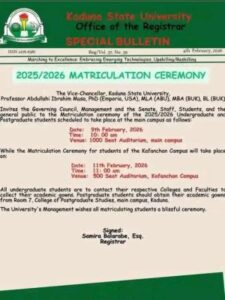
Join Our Community
Stay connected with the latest updates, exclusive content, and be part of our growing community!
Latest Posts
View AllFEDERAL UNIVERSITY, DUTSE ANNOUNCES HANDOVER CEREMONY FOR NEW VICE-CHANCELLOR

T
he management of the Federal University Dutse (FUD), Jigawa State, has reached a historic juncture in its administrative evolution. The incumbent Vice-Chancellor, Professor Abdulkarim Sabo Mohammed, has formally extended an invitation to the university community—comprising academic and non-academic staff, students, and key stakeholders—as well as the general public, to witness the official handover ceremony to the newly appointed Vice-Chancellor, Professor Ahmed Muhammad Gumel.
This event, scheduled for Tuesday, 10th February 2026, is more than a mere administrative ritual; it is a celebration of institutional stability, academic excellence, and the democratic transition of power within the Nigerian tertiary education system. As Professor Mohammed prepares to bow out after a tenure marked by significant growth, the arrival of Professor Gumel signals a new chapter for an institution that has rapidly become a beacon of learning in Northern Nigeria.
The Significance of the Leadership Transition
In the life of any higher education institution, the transition of leadership is a critical period that tests the strength of its internal structures. Federal University Dutse has, since its inception in 2011, maintained a reputation for orderly governance. The upcoming ceremony at the Nuhu Muhammadu Sanusi Auditorium serves as a public affirmation of this culture.
A Vice-Chancellor in the Nigerian university system is not just an administrator; they are the Chief Executive Officer, the Chief Academic Officer, and the “face” of the institution. They are responsible for navigating the complex intersection of government policy, academic standards set by the National Universities Commission (NUC), and the internal welfare of staff and students. Professor Abdulkarim Sabo Mohammed’s invitation to the public highlights his commitment to transparency, ensuring that the legacy of his administration is handed over with the dignity and decorum befitting a federal institution.
Ceremony Details and Protocol
The university has finalized logistics to ensure that the handover is both inclusive and grand. The following details are essential for all attendees:
-
Date: Tuesday, 10th February 2026
-
Time: 10:00 a.m. Prompt
-
Venue: Nuhu Muhammadu Sanusi Auditorium, Federal University Dutse
-
Key Participants: Outgoing Vice-Chancellor, Incoming Vice-Chancellor, Pro-Chancellor and Chairman of the Governing Council, Members of the University Senate, and Student Union Government (SUG) representatives.
The choice of the Nuhu Muhammadu Sanusi Auditorium is symbolic. Named after the late Emir of Dutse, the venue represents the strong bond between the university and its host community. Guests are advised to be seated by 9:30 a.m. to allow for the formal academic procession, which traditionally precedes such high-level events.
Reflecting on the Legacy of Professor Abdulkarim Sabo Mohammed
Professor Mohammed’s tenure will be remembered for its focus on “consolidation and expansion.” Under his leadership, FUD witnessed a surge in the accreditation of new programmes, particularly in the health sciences and specialized technology sectors. His administration prioritized the welfare of staff, ensuring that promotions and training were handled with meritocratic precision.
Beyond academics, his era saw the physical transformation of the campus. New faculty buildings, laboratory complexes, and improved student hostels were commissioned, creating a more conducive environment for learning. Perhaps his most enduring legacy is the stabilization of the academic calendar, ensuring that FUD students graduate on schedule despite the various external challenges facing the national education sector. This handover ceremony provides an opportunity for the community to show their appreciation for these milestones.
The Vision of the Incoming Vice-Chancellor: Professor Ahmed Muhammad Gumel
As the baton passes to Professor Ahmed Muhammad Gumel, there is a palpable sense of optimism within the university. Professor Gumel, an accomplished scholar with an extensive background in research and university administration, is expected to build upon the existing foundation while introducing innovative strategies to enhance FUD’s global ranking.
The challenges awaiting the new Vice-Chancellor are not insignificant. In an era of dwindling government subventions, Professor Gumel will likely need to focus on:
-
Internally Generated Revenue (IGR): Diversifying the university’s income through consultancy, agricultural ventures, and research grants.
-
Digital Transformation: Integrating Artificial Intelligence and advanced Learning Management Systems (LMS) into the curriculum.
-
Internationalization: Fostering partnerships with foreign universities to encourage faculty exchange and joint research projects.
-
Security and Welfare: Maintaining a safe campus environment while addressing the inflationary pressures affecting the livelihoods of staff and students.
A Call to the Stakeholders
The University Management emphasizes that this milestone belongs to everyone—from the cleaners and security personnel to the professors and external donors. The presence of the general public and traditional leaders at the ceremony underscores the fact that FUD is a “community university,” deeply rooted in the social fabric of Jigawa State.
For the students, this ceremony is a live lesson in leadership and institutional continuity. It reinforces the idea that while individuals come and go, the Federal University Dutse remains a permanent vessel for the pursuit of knowledge. The Student Union Government is expected to play a visible role in the ceremony, representing the voice of the primary constituents of the university.
Administrative Guidelines for the Handover Day
To ensure a smooth transition and maintain the solemnity of the event, the following administrative measures have been put in place:
-
Lecture Suspension: Academic activities will be briefly suspended on the morning of the 10th to allow staff and students to attend the ceremony.
-
Security Protocol: The University Security Unit, in collaboration with national security agencies, will manage traffic flow and parking around the Nuhu Muhammadu Sanusi Auditorium.
-
Media Coverage: The university’s Public Relations Unit will provide live updates for alumni and stakeholders who cannot attend in person.
Conclusion: Looking Toward the Future
The handover on February 10th represents the passing of a torch. It is a moment to look back at the achievements of the past five years and look forward to the possibilities of the next five. Under Professor Ahmed Muhammad Gumel, the Federal University Dutse is poised to strengthen its position as a leader in research and character building.
Professor Abdulkarim Sabo Mohammed’s final act as Vice-Chancellor—inviting the world to witness this change—is a testament to his confidence in the system he helped build. As the university community gathers in the Nuhu Muhammadu Sanusi Auditorium, the atmosphere will undoubtedly be one of gratitude, hope, and a collective resolve to keep “marching to excellence.”
Join Our Community
Stay connected with the latest updates, exclusive content, and be part of our growing community!
Latest Posts
View AllFederal University of Technology [FUTA] Suspends MBBS Admission for 2026/2027 Academic Session
![Federal University of Technology [FUTA] Suspends MBBS Admission for 2026/2027 Academic Session](https://www.campusinfo.com.ng/wp-content/uploads/2019/11/futa-2.jpeg)
The Federal University of Technology, Akure (FUTA) has officially announced that it will not admit students into its Bachelor of Medicine, Bachelor of Surgery (MBBS) programme for the 2026/2027 academic session.
This announcement was made public in a statement released on Tuesday by the university’s Registrar, Mr. C. O. Adeleye.
Who Is Affected?
The suspension affects all categories of applicants, including:
- UTME candidates
- Direct Entry (DE) candidates
- Candidates who already selected FUTA for MBBS during the ongoing JAMB UTME registration
In other words, no admission will be offered into the MBBS programme at FUTA for the 2026/2027 session, regardless of entry mode.
Important Advice to Candidates
FUTA has strongly advised candidates who selected the institution for MBBS to immediately change their choice of institution.
According to the statement:
Candidates who have picked FUTA for the MBBS programme during the ongoing UTME registration should seek admission into other institutions for the 2026/2027 academic session without delay.
This means affected candidates should use the JAMB Change of Institution option to avoid losing admission chances.

Join Our Community
Stay connected with the latest updates, exclusive content, and be part of our growing community!
Latest Posts
View AllNECO Releases 2025 GCE Results

The National Examinations Council (NECO) has officially released the 2025 NECO GCE results, bringing relief and excitement to thousands of candidates who sat for the examination across the country.
Candidates can now check their results online by visiting the NECO result portal. To access the result, candidates are required to provide their examination number and the result-checking token purchased from NECO-approved vendors.
Follow the steps below to easily check your NECO result online:
Step 1: Visit the NECO Result Portal
- Go to the official NECO result checking portal:
Step 2: Enter Your Examination Details
- Select your Examination Type (e.g. NECO GCE or NECO SSCE)
- Enter the Year of Examination
- Input your Examination Number
Step 3: Enter Result-Checking Token
- Scratch your NECO result-checking card
- Enter the Token Number in the space provided
Step 4: Click “Check Result”
- Your result will be displayed on the screen
- Carefully review your subjects and grades
Step 5: Print or Save Your Result
- You can print the result or save it as a PDF for future use
Join Our Community
Stay connected with the latest updates, exclusive content, and be part of our growing community!
Latest Posts
View AllZAMFARA STATE COLLEGE OF EDUCATION ISSUES IMPORTANT NOTICE ON COLLECTION OF NCE RESULT SLIPS

The Management of Zamfara State College of Education (ZSCOE), Maru, acting through the Office of the Registrar (Students’ Affairs Division), has released an essential directive regarding the availability of yearly examination result slips. This announcement is a vital administrative step designed to ensure that students maintain an accurate record of their academic progress and resolve any discrepancies before the commencement of the next phase of their education.
Academic transparency and record integrity are the hallmarks of ZSCOE Maru. By releasing these slips, the college enables students to verify their standing, calculate their cumulative grade point averages (CGPA), and ensure that all successfully completed courses are appropriately documented in the college’s central database.
Eligibility for Result Collection
The Registrar’s office has clearly defined the categories of students expected to participate in this exercise. It is mandatory for students in the following brackets to retrieve their physical result slips:
-
Present NCE II Students: Individuals currently in their second year of the Nigeria Certificate in Education (NCE) program.
-
Present NCE III Students: Final-year students who are nearing the completion of their academic journey.
-
Past NCE III Students: Alumni or former students who have completed their coursework but have yet to secure their official yearly result documentation.
For past students, these slips are often a prerequisite for the processing of final statements of results or the collection of the NCE certificate itself. Therefore, this window should be treated with the utmost priority.
Procedural Guidelines: Collection Period and Logistics
To ensure an orderly distribution process and avoid overcrowding, the college has designated a specific one-week window for the collection of these documents.
-
Start Date: Monday, 2nd February 2026
-
Closing Date: Friday, 6th February 2026
How to Collect Your Slip: Students are advised to bypass the central Registry and proceed directly to their respective School Examination Coordinators. Each school (e.g., School of Sciences, School of Arts and Social Sciences, etc.) has a dedicated coordinator who manages the localized records of students.
Requirements for Collection: While not explicitly stated in the brief memo, standard institutional practice at Zamfara State College of Education requires students to present:
-
A valid College Identity Card.
-
Evidence of registration/fee payment for the academic session in question.
-
A previous semester’s result slip (if applicable) to verify identity.
Addressing Academic Discrepancies: The Correction Window
The most critical aspect of this announcement is the provision for result complaints and corrections. It is not uncommon in large-scale academic processing for errors to occur—ranging from “Missing Results” and “Wrong Grade Entry” to “Incorrect Credit Unit Allocation.”
The college has provided a strict timeline for students to audit their results and report errors:
Deadline for Complaints: Saturday, 14th February 2026
The Resolution Process: If a student discovers an anomaly on their slip, they must not wait. The following steps should be taken:
-
Draft a formal complaint: Clearly state the course code, course title, the semester involved, and the nature of the error.
-
Submit to the Coordinator: Hand the complaint to the School Examination Coordinator, who will then cross-check the slip against the original “Master Broadsheet” signed by the lecturer and the Head of Department (HOD).
-
Regularization: Once the error is verified, the coordinator facilitates the correction through the Academic Office to ensure the student’s portal and physical records are updated.
Warning: Complaints submitted after the February 14th deadline may be rejected, as the college will have proceeded to the final computation of broader academic records.
Administrative Responsibility and Communication
The notice was officially signed by Suleman Ladan, the Dean of Students’ Affairs, writing on behalf of the Registrar. This highlights the collaborative effort between the academic and administrative wings of the college to prioritize student welfare.
The management has also issued a “call to action” for the student body. Students are strongly encouraged to inform their peers, course mates, and graduated seniors who may no longer be on campus. Since the collection window is brief, word-of-mouth and social media sharing are essential to ensure no student is left behind.
Why This Exercise Matters for Your Career
For an NCE student, the yearly result slip is more than just a piece of paper; it is a legal document that validates your transition from one level to the next. For those intending to pursue a Direct Entry (DE) admission into a university later, these slips form the basis of your transcript. Ensuring they are correct now prevents significant administrative hurdles in the future.
Final Reminders:
-
Dates: Feb 2nd – Feb 6th (Collection).
-
Complaint Deadline: Feb 14th.
-
Contact: School Examination Coordinators.
The management of Zamfara State College of Education, Maru, wishes all students a successful session and encourages everyone to be proactive in managing their academic records.
Join Our Community
Stay connected with the latest updates, exclusive content, and be part of our growing community!
Latest Posts
View AllSOKOGA COLLEGE OF HEALTH SCIENCE AND TECHNOLOGY, KEFFI ANNOUNCES ADMISSION FORM FOR 2025/2026 ACADEMIC SESSION

KEFFI, NIGERIA — The management of Sokoga College of Health Science and Technology (SOCOHST), a rising center for medical vocational training in Nasarawa State, has officially opened its doors for the 2025/2026 academic session. Aspiring healthcare professionals are invited to apply for various specialized diploma and certificate programs designed to address the critical manpower shortage in the Nigerian healthcare delivery system.
Positioned in the heart of Keffi, the institution has built a reputation for combining rigorous academic training with practical clinical exposure. This admission cycle represents a strategic opportunity for secondary school leavers and “retrainees” (practicing junior health workers) to upgrade their skills and secure a licensed career path.
Academic Programs and Career Specializations
The college offers a diverse array of programs, each regulated by their respective national professional bodies to ensure that graduates are eligible for professional licensing upon completion.
1. Community Health
This program is the backbone of primary healthcare in Nigeria. It trains students to serve as the first line of medical defense in rural and urban communities.
-
Specializations: Professional Diploma in Community Health (CHEW) and Certificate in Community Health (JCHEW).
-
Career Path: Community Health Officers, Primary Healthcare Managers.
2. Medical Laboratory Technician (MLT)
Students are trained in the science of diagnostics, learning to perform chemical, hematological, and microbiological analyses of body fluids.
-
Scope: Covers clinical chemistry, medical microbiology, and histopathology.
-
Career Path: Laboratory Technicians in hospitals, diagnostic centers, and research institutes.
3. Pharmacy Technician
This course focuses on the pharmaceutical sciences, drug management, and the legal frameworks governing medication in Nigeria.
-
Scope: Training in drug dispensing, pharmacology, and inventory management.
-
Career Path: Pharmaceutical assistants in hospitals or community pharmacies.
4. Public Health
Focusing on population health rather than individual clinical treatment, this program covers epidemiology, disease surveillance, and health promotion.
-
Career Path: Health Inspectors, Disease Surveillance Officers, and NGOs.
5. Dental Technology
A highly technical field focused on the fabrication of dental prosthetics, including crowns, bridges, and dentures.
-
Career Path: Dental Technologists in dental clinics and maxillo-facial units.
Admission Requirements: What You Need
To maintain high standards, Sokoga College adheres to the entry requirements set by the National Board for Technical Education (NBTE) and various health professional councils.
Standard Entry Requirements:
-
O’Level Credits: Candidates must possess a minimum of five (5) credits in SSCE (WAEC, NECO, or NABTEB) obtained in not more than two sittings.
-
Core Subjects: The credits must include English Language, Mathematics, Biology, Chemistry, and Physics.
-
Age/Health Status: Applicants must be at least 16 years old and provide a certificate of medical fitness upon admission.
Special Note for Retrainees: Practicing JCHEWs or Medical Laboratory Assistants who wish to upgrade to CHEW or MLT status must present their current practicing licenses and evidence of previous certifications.
Application Procedure: How to Secure Your Form
Interested candidates are required to obtain their application forms physically at the college’s designated sales points. This ensures that applicants receive the official brochure and immediate counseling regarding their course of choice.
| Location | Specific Address |
| Sokoga Group of Schools | Located behind the Keffi Township Stadium, Keffi. |
| Sokoga Preparatory School | Located behind Lowcost Akwanga Express By-Pass. |
Application Fee: While fees are subject to slight administrative changes, candidates are advised to budget approximately ₦10,000 for the application form and processing.
Why Choose Sokoga College?
Choosing an institution for health science education requires careful consideration of accreditation and practical facilities. Sokoga College stands out for several reasons:
-
Professional Licensing: The college prepares students for national council examinations, ensuring that your certificate is recognized for employment in both the public and private sectors.
-
Modern Facilities: From well-equipped medical laboratories to dental technology workshops, students learn using tools they will encounter in real-world hospitals.
-
Strategic Location: Located in Keffi, the college enjoys proximity to major tertiary health institutions like the Federal Medical Centre (FMC), Keffi, providing ample opportunities for clinical attachments and internships.
Contact for Inquiries and Support
The college administration has provided dedicated lines for call and WhatsApp inquiries to assist candidates with the registration process or technical difficulties.
-
Admission Hotline 1: +234 803 588 2074
-
Admission Hotline 2: +234 803 636 3176
-
Admission Hotline 3: +234 803 971 7168
Building a Future in Healthcare
In the modern economy, healthcare remains one of the most stable and rewarding career paths. Whether you choose to work in a diagnostic lab, manage a pharmacy unit, or lead community health initiatives, a diploma from Sokoga College of Health Science and Technology provides the professional foundation you need.
Remember, in the medical world, Health is Wealth, and your journey toward becoming a licensed health professional begins with this single step.
Join Our Community
Stay connected with the latest updates, exclusive content, and be part of our growing community!
Latest Posts
View AllUNIVERSITY OF AFRICA, TORU-ORUA (UAT) SECURES NUC APPROVAL FOR NEW POSTGRADUATE PROGRAMMES

The National Universities Commission (NUC), the regulatory body overseeing the standards and quality of university education in Nigeria, has officially authorized the University of Africa, Toru-Orua (UAT), Bayelsa State, to broaden its academic horizons. This landmark approval allows the institution to commence several new postgraduate programmes, signaling a new era of advanced research and specialized training within the state and the Niger Delta region.
The Path to Accreditation: Resource Verification
This authorization was not merely administrative; it was earned through a rigorous resource verification visit conducted by a high-powered panel of academic experts and NUC officials. During the visit, the panel meticulously assessed both the human and material resources available at UAT. This included:
-
Faculty Strength: Evaluating the availability of senior academic staff, specifically Professors and Associate Professors, capable of supervising PhD and Masters research.
-
Infrastructure: Inspecting state-of-the-art laboratories, specialized studios for Theatre and Film Studies, and advanced computing facilities.
-
Library Resources: Assessing the depth of physical and digital repositories available to postgraduate scholars.
In a formal letter dated January 30, 2026, and signed by the Director of Academic Planning, Abubakar M. Girei, on behalf of the Executive Secretary, the Commission expressed satisfaction with the university’s readiness. Consequently, UAT is now empowered to admit students into these programmes effective from the 2025/2026 academic session.
Comprehensive List of Approved Programmes
The approval is extensive, covering three distinct tiers of postgraduate education: Postgraduate Diploma (PGD), Masters (M.Sc., M.Ed., M.A., MBA), and Doctor of Philosophy (PhD). The following academic disciplines have been greenlit:
Management and Social Sciences
-
Accounting: PGD, M.Sc., and PhD.
-
Business Administration: PGD, M.Sc., PhD, and the professional Master of Business Administration (MBA).
-
Mass Communication: PGD, M.Sc., and PhD.
-
Political Science: PGD, M.Sc., and PhD.
Sciences and Technology
-
Biology: PGD, M.Sc., and PhD.
-
Biochemistry: PGD, M.Sc., and PhD.
-
Computer Science: PGD, M.Sc., and PhD.
Arts and Education
-
Educational Management: PGD, M.Ed., and PhD.
-
Theatre and Film Studies: PGD, M.A., and PhD.
Strict Regulatory Guidelines for Implementation
The NUC’s approval comes with a set of stringent “Important Guidelines for Implementation.” These mandates are designed to ensure that the quality of education does not dilute as the university scales its operations.
1. Full-Time Mode Only
The Commission was explicit in stating that this approval is strictly for full-time mode. This requirement ensures that both students and supervisors can dedicate the necessary time to intensive research and coursework. If the University of Africa intends to introduce part-time versions of these programmes to cater to working professionals, it must notify and seek a separate approval from the NUC after demonstrating additional resource capacity.
2. Adherence to Nomenclature
UAT is mandated to maintain the approved titles and nomenclature for all degrees. For instance, a degree approved as an M.Sc. in Computer Science cannot be unilaterally rebranded as an M.Tech. without prior NUC authorization. This consistency is vital for the global recognition of certificates and the international mobility of UAT graduates.
3. Continuous Resource Maintenance
The NUC emphasized that accreditation is not a one-time event but a continuous state. The university must provide continuous adequate human and material resources. This means as student populations grow, the university must proportionally increase its faculty count and laboratory equipment to maintain the teacher-to-student ratios mandated by the NUC.
Impact and Institutional Significance
This development marks a significant expansion for the University of Africa, Toru-Orua. By moving into the realm of PhD and Masters education, UAT is transitioning from a primarily teaching-oriented institution to a research-intensive university.
Key benefits of this expansion include:
-
Regional Development: Providing Bayelsa State and neighboring regions with a local hub for high-level manpower development, particularly in critical fields like Biochemistry, Accounting, and Computer Science.
-
Research Innovation: PhD candidates at UAT will now be able to tackle local challenges—such as environmental issues in the Niger Delta or local governance—through rigorous scholarly inquiry.
-
Institutional Prestige: The ability to grant Doctor of Philosophy degrees significantly boosts the university’s standing in global rankings and attracts international research grants and collaborations.
The Future of Theatre and Film Studies
The inclusion of Theatre and Film Studies up to the PhD level is a particularly strategic move. Given the cultural richness of Bayelsa and the global impact of the Nigerian film industry (Nollywood), UAT is positioned to become a premier training ground for the next generation of film scholars, directors, and cultural administrators.
Conclusion: A Call to Prospective Scholars
With the 2025/2026 academic session fast approaching, the University of Africa, Toru-Orua, is now ready to welcome its first cohort of advanced scholars. This NUC approval serves as a seal of quality and a promise of academic rigor. For professionals in the civil service, the tech sector, and the arts, UAT now offers a clear pathway to reaching the pinnacle of their academic careers without leaving the region.
The management of UAT has expressed its readiness to implement these programmes with the highest level of integrity, ensuring that Toru-Orua becomes synonymous with academic excellence and innovation.
Join Our Community
Stay connected with the latest updates, exclusive content, and be part of our growing community!