
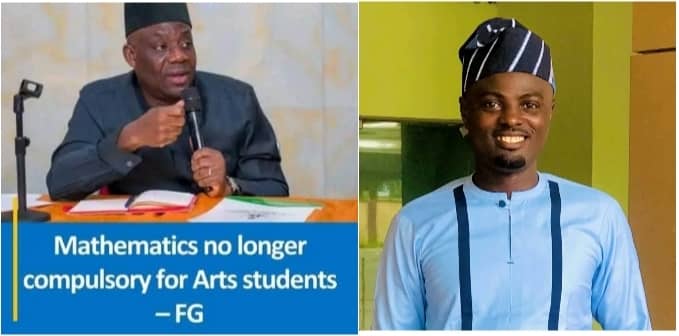
Removing Mathematics as a Compulsory Subject for Arts Students: Balancing Access with Global Realities

The Federal Government of Nigeria recently approved the removal of Mathematics as a compulsory subject for students seeking admission into arts and humanities programmes. While the move aims to ease access and reduce academic pressure on students whose strengths lie in language, literature, and creativity, it has stirred a national conversation about the value of mathematics in education and employability.
Globally, there is no single rule on whether mathematics should be compulsory for all learners. Countries design their education systems around their economic needs, labour markets, and learning capacities. For instance, many European and Asian nations retain compulsory mathematics up to the end of secondary school, ensuring all students achieve basic numeracy before specialisation. In contrast, some systems in North America and Australia allow flexibility, letting students in arts or humanities replace advanced mathematics with courses in data literacy, logic, or statistics relevant to their field.
At the heart of this debate is the question: What kind of mathematics do all students really need? The modern global view emphasises “functional numeracy”, the ability to reason with numbers, understand data, and apply quantitative thinking to everyday and professional problems. This skill set supports decision-making in civic life, business, and digital communication. Thus, while not every student requires calculus or algebra, all benefit from the capacity to interpret figures, analyze trends, and engage with the data-driven world.
Nigeria’s case is unique. For years, Mathematics has been one of the major barriers to university admission, especially for students from rural or under-resourced schools. Many intelligent and creative students in arts disciplines struggle to pass Mathematics at the required level due to poor teaching quality, lack of instructional materials, and a rigid examination culture. By removing the subject as a compulsory entry requirement, the government hopes to promote inclusivity and reduce wastage in the system.
However, the decision also carries risks. The Nigerian labour market increasingly values numeracy and digital literacy, even in traditionally non-scientific fields such as media, communication, law, and the arts. Graduates lacking basic data skills may find themselves at a disadvantage in a world where digital tools and analytical reasoning are becoming essential. Without strong alternatives, the policy could inadvertently deepen the skill gap between Nigerian graduates and their global peers.
The most balanced approach would be to reform, not remove, Mathematics. Instead of eliminating it completely for arts students, Nigeria could redesign the curriculum to include practical numeracy, courses that teach statistics, budgeting, logic, and data interpretation through real-life applications in the humanities. Such reform would maintain access while preparing students for modern work demands.
In the end, the issue is not about whether arts students should “do math,” but about ensuring every Nigerian student leaves school with the quantitative confidence to thrive in today’s economy. The removal of Mathematics as a compulsory subject should be an opportunity for innovation, not a step back from the global movement toward inclusive and practical education.
Yahya O. Isiaq PhD
Lagos State University

Join Our Community
Stay ahead with exclusive campus news, admission updates, scholarships and student opportunities.
You May Also Like
More




Be the first to comment